
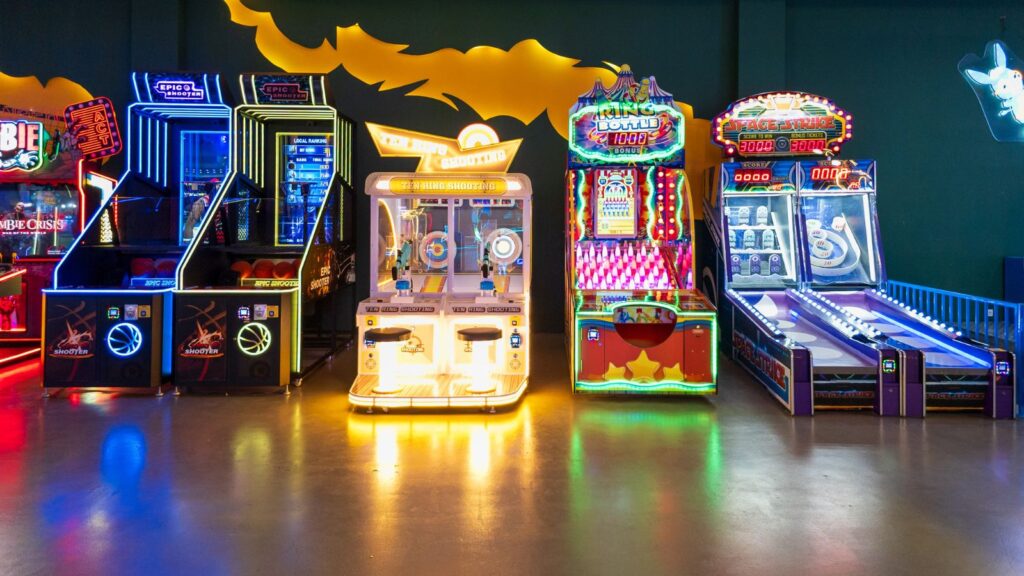
This article explores the brutal history of arcade gaming, focusing on the titles designed specifically to challenge the limits of human reflexes and patience. We examine the mechanical design behind high-stakes difficulty, the psychological tactics used by developers to keep players inserting coins, and the legacy of these punishing classics. From bullet-hell shooters to rhythm games that demand superhuman coordination, we analyze the evolution of “arcade hard” and the dedicated community of players who continue to chase perfect scores against impossible odds
Cruel Cabinets: The Most Punishing Arcade Games of All Time
In the neon-lit corridors of the 1980s and 90s, the arcade cabinet was more than just a source of entertainment; it was a carefully calibrated business model. Unlike modern home consoles where players pay once for an experience, arcade machines were designed to maximize revenue by keeping sessions short and intense. This economic reality gave birth to “arcade difficulty,” a level of challenge so steep that success often felt like a momentary reprieve from inevitable failure. Developers mastered the art of the “quarter-eater,” creating games that lured players in with vibrant graphics and catchy soundtracks, only to crush them with unforgiving mechanics within the first few minutes of play.
This high-pressure environment required players to possess a unique combination of muscle memory, pattern recognition, and nerves of steel. For many enthusiasts, the thrill of overcoming an impossible level was comparable to the high-stakes excitement found in professional competition. Just as modern fans break down strategies, statistics, and probabilities on platforms like apuestas deportivas futbol before making informed decisions, arcade masters of the past would study the exact frame data of boss attacks and pixel-perfect safe spots. This analytical approach transformed gaming from a casual hobby into a rigorous pursuit of perfection, where the margin for error was non-existent and the cost of a single mistake was literally another coin from your pocket.
Ghosts ‘n Goblins and the Armor of Frustration
Capcom’s Ghosts ‘n Goblins remains one of the most notorious examples of a game that hates its players. Released in 1985, it introduced the world to Arthur the Knight, a hero whose armor would shatter after a single hit, leaving him vulnerable in his boxers. The game’s difficulty didn’t just stem from the relentless swarms of zombies and red Arremers; it was the unpredictable nature of enemy spawns that kept players in a state of constant anxiety. Unlike many contemporaries that relied on static patterns, this title forced players to react to chaotic variables, making every run feel like a desperate struggle for survival.
The true cruelty of Ghosts ‘n Goblins, however, was revealed at what players thought was the end. After battling through six grueling stages of hellish difficulty, the game informs the player that the entire journey was a “trap devised by Satan” and forces them to replay the entire game from the beginning on a higher difficulty level to see the true ending. This design choice is legendary in the annals of gaming history for its sheer audacity. It served as a psychological barrier that only the most dedicated—or perhaps the most masochistic—gamers could overcome, solidifying Arthur’s quest as a benchmark for arcade endurance that few have matched since.
The Vertical Nightmare of Donkey Kong
While modern players might view Donkey Kong as a charming relic of the past, the original 1981 arcade cabinet is a masterclass in escalating tension and environmental hazards. Nintendo’s debut masterpiece was one of the first “platformers,” but it offered no room for the fluid movement seen in later titles. Jumpman’s mobility was severely limited; a fall from even a slight height resulted in an immediate loss of life. The game’s difficulty was also famously affected by a programming quirk known as the “Kill Screen,” where a bug in the level counter made the 22nd stage impossible to complete, effectively ending any perfect run.
The brilliance of the game lay in its use of random physics. The barrels thrown by the giant ape did not always follow the same path, sometimes skipping ladders or changing direction unexpectedly. This meant that players couldn’t simply memorize a route; they had to develop an intuitive “feel” for the game’s chaotic logic. This era of gaming demanded a level of focus that is rarely seen today. To reach the top of the construction site, one had to master the timing of elevators and the arc of fireballs, all while fighting against a timer that seemed to tick faster with every passing level, ensuring that only the elite would ever see the later stages.
Defender and the Complexity of Control
If Donkey Kong was a test of timing, Williams Electronics’ Defender was a test of cerebral processing and manual dexterity. Released in 1981, it was widely considered the most complex arcade game of its time due to its control scheme. While most games used a simple joystick and one or two buttons, Defender featured a joystick for vertical movement and five separate buttons for thrust, reverse, fire, hyperspace, and smart bombs. Navigating a ship at high speeds while defending humans from alien abductors required a level of hand-eye coordination that many found overwhelming.
The screen in Defender was constantly filled with fast-moving sprites, and the player had to monitor a long-range radar at the top of the screen to identify threats off-camera. This multitasking was revolutionary but punishing. If an alien successfully abducted a human and reached the top of the screen, they would transform into a hyper-aggressive “mutant” that chased the player relentlessly. The resulting chaos often led to a sensory overload that caused even experienced players to panic. Its difficulty was so legendary that it became a status symbol in arcades; being a “Defender master” meant you possessed a level of mental agility that few others could claim.
Robotron: 2084 and Sensory Overload
Eugene Jarvis followed the success of Defender with Robotron: 2084, a game that stripped away complex navigation in favor of pure, unadulterated carnage. It was the pioneer of the “twin-stick shooter” genre, using one joystick for movement and another for firing in eight directions. The difficulty here was not found in intricate puzzles or platforming, but in the sheer volume of enemies on the screen. The game could handle up to sixty objects moving simultaneously, creating a kaleidoscopic whirlwind of death that forced the player into a constant state of fight-or-flight.
The player’s objective was to save the last human family while being hounded by “Grunts,” “Hulks,” and “Spheroids.” Because enemies spawned from all sides of the screen, there was no safe corner to hide in. Success in Robotron required a trance-like state of focus where the player stopped thinking and started reacting purely on instinct. The game’s speed increased exponentially with every level, eventually reaching a point where the human brain could barely process the incoming data. It remains a definitive example of “high-action” difficulty, where the only way to survive was to become as fast and efficient as the machines trying to kill you.
The Bullet Hell of DoDonPachi
As arcade technology advanced into the 1990s, a new sub-genre of shooters emerged that would take difficulty to a psychological level: the “Bullet Hell” or manpaku. Cave’s DoDonPachi is often cited as the father of this movement. In these games, the screen is frequently covered almost entirely by thousands of colorful projectiles moving in intricate, overlapping patterns. The player’s hitbox is reduced to a single pixel at the center of their ship, and survival depends on navigating through gaps that are often only slightly wider than the ship itself.
The difficulty of DoDonPachi is not just about dodging; it is about the “chaining” system required to get high scores. Players must destroy enemies in a specific rhythm to maintain a combo, which forces them to take dangerous risks rather than playing defensively. This creates a paradox where the player must move aggressively through a lethal storm of fire to succeed. The final boss, Hibachi, is legendary for being one of the most difficult encounters in gaming history, featuring attack patterns that seem physically impossible to navigate. These games aren’t just tests of skill; they are visual puzzles that require the player to see through the chaos and find the hidden path to safety.
Dragon’s Lair and the Trial of Memory
In 1983, Dragon’s Lair arrived in arcades and looked unlike anything anyone had ever seen. Utilizing LaserDisc technology, it featured high-quality animation by former Disney animator Don Bluth. However, behind its stunning cinematic visuals lay one of the most frustrating and unforgiving gameplay loops in history. The game was essentially a series of “Quick Time Events” before the term existed. Players had to move the joystick or press the fire button at precise moments during the animation to avoid instant death, with almost no visual cues to guide them.
The difficulty of Dragon’s Lair was entirely based on trial and error. There was no logic to many of the traps; a player would die simply because they didn’t know they had to move left in a specific frame. This meant that the only way to beat the game was through total memorization of the entire sequence. One mistake meant watching a death animation and starting the scene over, which quickly drained a player’s budget. It was a polarizing experience that substituted mechanical skill for rote memorization, creating a unique type of arcade difficulty that relied on the player’s wallet as much as their memory.
Dance Dance Revolution and Physical Exhaustion
Difficulty in the arcade wasn’t always limited to fingers and joysticks; the rise of rhythm games introduced a physical element that challenged the player’s stamina and aerobic capacity. Dance Dance Revolution (DDR), particularly on “Challenge” or “Extra Stage” modes, required players to perform complex footwork at speeds exceeding 200 beats per minute. At the highest levels of play, the arrows on the screen became a continuous blur, requiring players to memorize the rhythm of the song and use the bar behind them for support just to keep up.
The difficulty of games like DDR or Beatmania IIDX is unique because it introduces the factor of physical fatigue. A player might have the mental capacity to read the notes, but their legs or arms might fail them halfway through a grueling ten-minute set. This turned the arcade into a gymnasium, where the best players were often those with the most physical endurance. The precision required is staggering, with “Marvelous” or “Perfect” timings measured in milliseconds. Overcoming a difficult chart in a rhythm game provides a visceral, full-body sense of accomplishment that is fundamentally different from the stationary experience of traditional arcade titles.
Gauntlet and the Dwindling Health Bar
Atari’s Gauntlet (1985) introduced a different kind of difficulty: the systemic pressure of a constantly depleting health bar. In this dungeon crawler, “your health is fading,” and the only way to stay alive was to find food or insert more coins. While the game allowed for four-player cooperative play, the sheer number of enemies and the design of the mazes made it a war of attrition. The game was designed to be endless, with over 100 unique levels that eventually started repeating, but the primary enemy was always the clock.
This “pay-to-stay-alive” mechanic was a brilliant but brutal way to ensure a constant flow of revenue. Even the best players would eventually succumb to health loss if they didn’t move fast enough. Gauntlet rewarded aggressive efficiency, but punished greed; if you stopped to grab treasure while a generator was spawning ghosts, you were essentially paying for that treasure with your life. It fostered a sense of urgency that was palpable, especially when players had to decide whether to share limited food resources or let a teammate die so they could survive a few seconds longer. It was a test of both tactical speed and social dynamics under pressure.
Conclusion
In conclusion, the most difficult arcade games of all time were more than just entertainment; they were gauntlets thrown down by developers to test the absolute limits of human potential. These games were born from a unique economic moment where difficulty was a feature, not a bug, designed to create a cycle of challenge, failure, and eventual mastery. While the era of the smoke-filled arcade has largely faded, the spirit of these “quarter-eaters” lives on in the modern “Soulslike” genre and the dedicated speedrunning communities that continue to push these classic games to their breaking points.
The enduring appeal of these punishing titles lies in the purity of the challenge they offer. There are no difficulty sliders, no microtransactions to skip levels, and no hand-holding tutorials. There is only the player, the cabinet, and the relentless logic of the code. Achieving a high score on a machine like Defender or DoDonPachi remains a badge of honor, representing hundreds of hours of practice and a refusal to back down from an impossible task. As long as there are gamers who crave the thrill of overcoming the insurmountable, the legends of these difficult arcade classics will continue to be told, one credit at a time.